
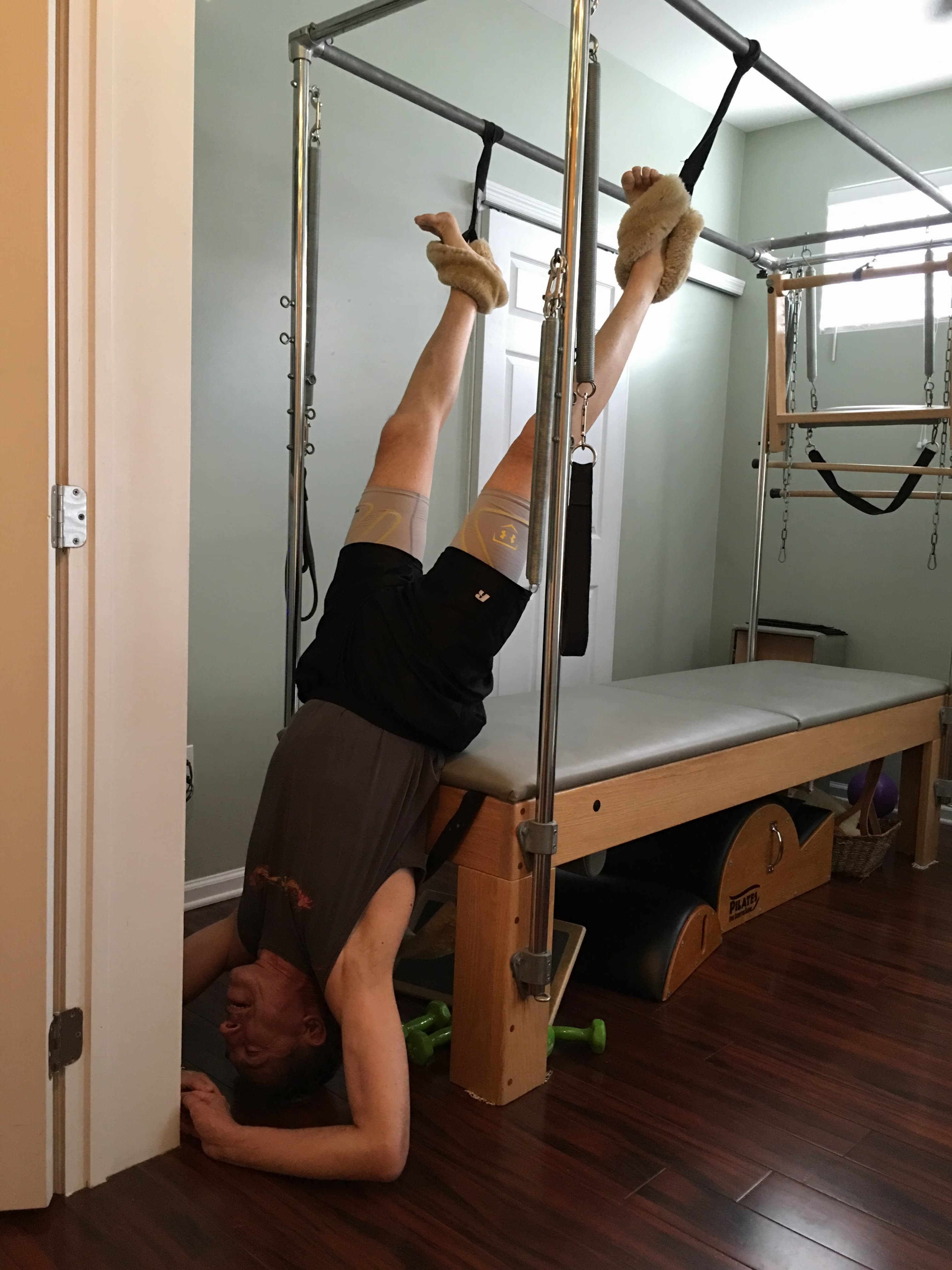
What Does ‘Gripping’ Actually Mean?
When we talk about hip flexor gripping, we are describing that feeling of tension, cramping, or overworking at the very front of the hip joint, often right where your thigh meets your pelvis. It can feel like the muscle is working too hard, or even shaking or pinching, especially during exercises like the Hundred, leg circles, or any movement that asks you to hold a leg up or move it in space.
Here is the key thing to understand: the gripping is almost never a strength problem. It is a coordination problem. The body is reaching for a muscle it knows how to fire easily, the hip flexor, and using it to do a job that should be shared by many other muscles working together. When we see this pattern in our Group Reformer classes or during a Private session, our instructors treat it as great information. It tells us exactly where to focus the teaching.
The Real Job: Controlling Your Hip and Pelvic Position
The deeper lesson underneath the gripping pattern is this: the body does not yet know how to hold a stable, neutral pelvis and hip position while the leg is moving. So the hip flexor steps in and essentially tries to anchor everything by working overtime. It is the body doing its best with the tools it has available in that moment.
What we want to teach instead is a different kind of stability. We want the pelvis to stay still and connected, the deep abdominals to do the holding work, and the hip joint to be free to move without that front-of-hip tension taking over. This is a learned skill, and it takes patient, thoughtful repetition. That is exactly why classical Pilates, with its precise cueing and progression, is so well suited to rewiring this pattern.
Think of it this way: the hip flexor is a mover. It wants to create motion. When we ask it to be a stabilizer instead, it gets confused and grips. Our job as instructors is to help your nervous system find the true stabilizers, your deep core, your glutes, your inner thighs, so the hip flexor can relax into its proper role.
How We Teach It at Lowcountry Power Pilates Studio
Our instructors, Catherine, Emily, Jill, Joanelle, Joyce, Kelly, and Wendy, are trained to spot this pattern early and address it with specific cueing and thoughtful exercise selection. In a Private session or a Duet, we have the most direct opportunity to slow things down and work with exactly what your body needs. But even in a Group Reformer or Group Mat and Tower class, our instructors are watching and offering adjustments to help you find better mechanics.
Practically speaking, here is what the correction process looks like. First, we often reduce the load. That might mean bending the knee, lowering the lever, reducing the spring tension on the Reformer, or bringing the leg closer to the body. A smaller range of motion with control is always more valuable than a large range of motion with gripping. Second, we direct attention to the pelvis. We ask clients to notice whether the lower back is pressing into the mat or curling under, whether the hip bones are staying level, and whether there is any rocking or shifting happening. Third, we bring awareness to the breath. Exhaling through the effort helps the deep abdominals engage and often releases that gripping sensation naturally.
Over time, with consistent practice, the body begins to learn the new pattern. The pelvis stays steady, the movement becomes fluid, and the hip flexor stops trying to do everyone else’s job. This is one of the most satisfying progressions to watch as an instructor, and one of the most freeing things our clients describe feeling in their own bodies.
What You Can Do Right Now
If you have been noticing this gripping sensation in your own practice, here is one simple place to start before your next class. Lie on your back with your knees bent and feet flat. Take a breath in, and as you exhale, gently draw your lower belly in and notice whether your pelvis stays perfectly still. Now try lifting just one foot one inch off the floor, keeping the knee bent. Did your lower back flatten out or pop up? Did you feel tension rush into the front of your hip? If so, that is the pattern we are talking about, and it is completely addressable.
Bring this awareness into your next session and mention it to your instructor. That kind of specific, honest feedback helps us help you. At Lowcountry Power Pilates Studio, we believe that real, visible results come from this kind of attentive, individualized work, and we love when our community brings their curiosity and questions to the floor with them.
In Health, Joyce & LCPP team
#MtPleasantPilatesStudio, #FindYourTribe, #InspirationIsContagious, #MindfullMovement, #Strength #Length, #Balance, #Flexibility